


The offseason is when football gets quiet enough to actually see it.
April gave me that view. Not from one place, but from a constant movement between two worlds that couldn’t have felt more different, yet are deeply connected.
For most of the month, I lived inside college football programs. Meeting rooms before sunrise, practice fields buzzing with energy, long conversations with head coaches, coordinators, and players who are all chasing something meaningful. And then, almost as quickly as I’d arrive, I’d head home—back to being Dad—pulling into a parking lot just in time to catch my kids’ practices, games, or a few minutes of them just being kids.
It became a rhythm that I didn’t plan, but one that revealed more than I expected. Travel, immerse, return. Learn, observe, then sit quietly and support. And over time, a contrast began to take shape.
It started in Southern California at USC where the Trojans look the part and in my eyes, have a blue collar mentality. It was then out to Lincoln, sitting down with Matt Rhule. We dove into a deep conversation about this generation of athletes—how they think, how they process, what they need from the people leading them. It wasn’t framed as a challenge as much as it was a responsibility for coaches, mentors and now, even agents.
From there, I headed into the Midwest and found myself alongside colleague and friend Todd Blackledge. Our first collective sojourn began in Illinois with Bret Bielema, sitting in a team meeting and watching him teach. Not perform, not fill space—teach. There was clarity, there was alignment, and there was an understanding that every word mattered because every player was listening.
That same thread carried into conversations with Barry Lunney Jr. and Bobby Hauck. Different backgrounds, different journeys, but the same intentionality. The same commitment to creating an environment that players could feel the moment they walked in.
When we sat with quarterback Katin Houser, he gave language to something Todd and I had been sensing all day. He told us, “the hallways here are warm.” He described what it felt like to move through the building—people acknowledging him, checking in, making him feel seen. It wasn’t said for effect. It was just his reality. And it hit me that culture rarely shows up in the big moments we like to highlight. It lives in the small, repeated actions that most people never notice. And everyone needs it, even big time QBs.
That idea stayed with me as I drove late into the night with Todd. Those drives have a way of slowing everything down just enough to actually process what you’re seeing. We talked about life, about family, about the role we play in telling these stories. I tried to ask questions and absorb Todd’s wisdom, as it’s plentiful and powerful. In many ways, that conversation became a through line for the rest of the trip. Football. Family. Purpose. (And some Big East memory lane conversation as we loved on Ted Robinson—whom we both shared a booth with, and much more)
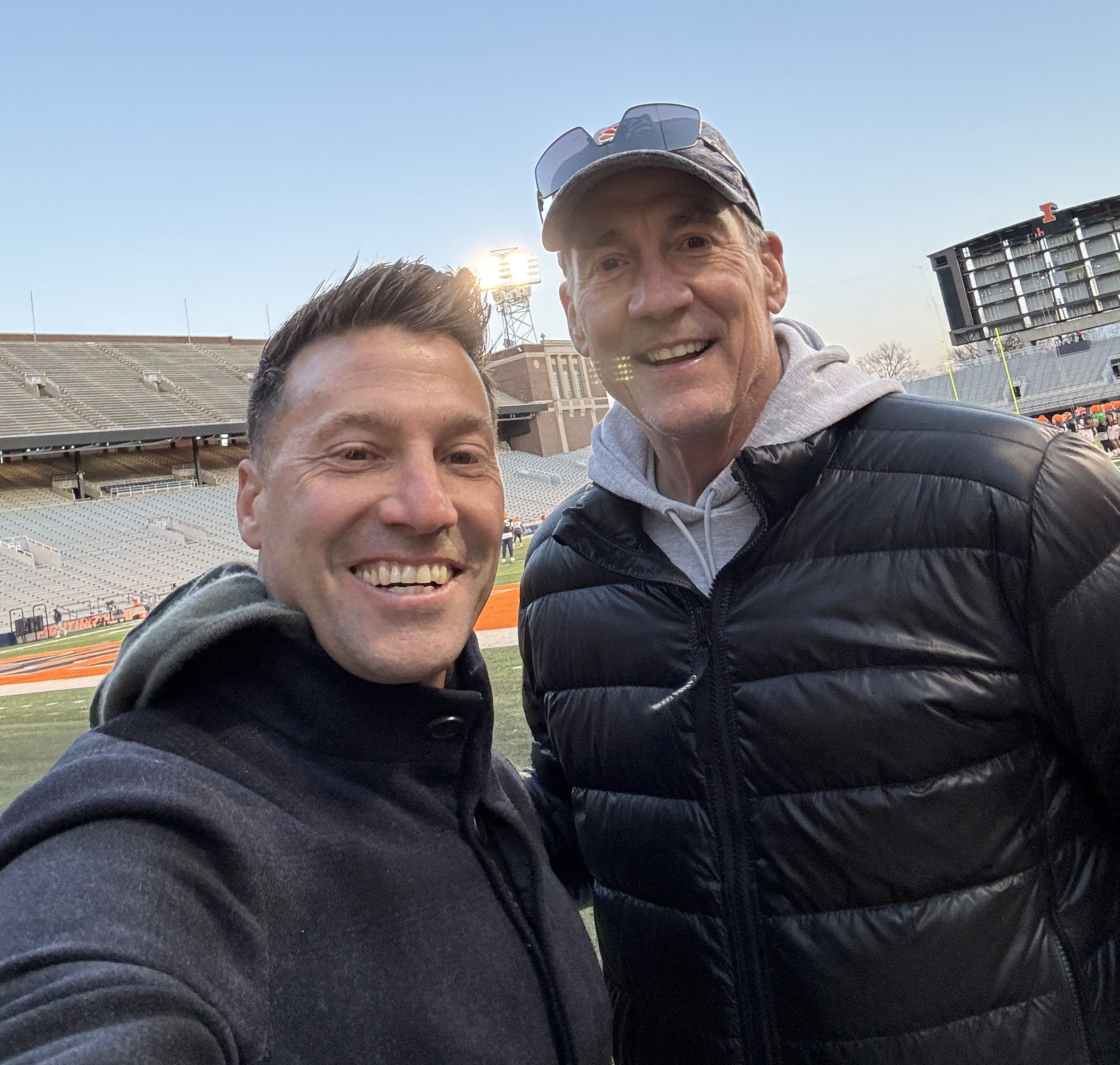
At Indiana, with Curt Cignetti, I went in expecting to see a rigid standard. What we saw instead was something much more alive. The discipline was real, but it didn’t feel restrictive. It felt shared. The players weren’t weighed down by expectations—they were connected through them. The competing had joy in it. The clarity created freedom. It was a reminder that when a standard is truly lived, it becomes something people rally around, not something they resist.
That feeling carried into South Bend, walking a campus I hadn’t seen in two decades, and then sitting in a meeting room the next morning with Marcus Freeman. Watching him lead, you notice what’s not said just as much as what is. There’s a presence, a calm, and an understanding that leadership isn’t about controlling every moment. It’s about creating an environment where others can step into their own. Those lessons I took home to our kids, or at least competed to do so.
The same idea showed up again in Chicago with David Braun, where belief and development were woven into the fabric of the program. It was equally inspiring to watch Chip Kelly, who I believe is a College Football Hall of Fame coach, continue to evolve. Still curious. Still learning. Still asking questions.
Chip once told me: “you’re not a real coach until you’ve been on the yellow bus.”
That line never leaves you.
Because it’s a reminder that this game, at its core, is about people long before it’s about performance.
Next was Columbus, sitting with Ryan Day, that same principle was framed in a way I won’t forget. His job, as he described it, is to pour into his players. Not manage them, not simply prepare them—but invest in them fully. And when you spend time around his team, you feel that. It shows up in how they talk, how they interact, how they carry themselves. And Julian Sayin is only going to take the next step.
Back west, that thread continued in Eugene with Dan Lanning, where his DNA traits—connection, growth, toughness, sacrifice—are not just concepts, but lived behaviors. You see it in players like Poncho Lalaulu, who chose to return because of the culture around him.
In Seattle with Jedd Fisch, we talked about relationships and how they anchor players through uncertainty. In a time where so much is fluid, that consistency matters more than ever.
Next it was a place I used to visit regularly: Tucson, Arizona. Spending a day and half with Brent Brennan’s Wildcats was energizing as he has everything in order to take a legit run at the Big-12 title this fall. Add in Noah Fifita and one can’t help but feel like you can achieve any dream on your vision board. Stay tuned for deep dive podcasts with both Coach Brennan and dark horse Heisman candidate, Fifita. (Drops this week)
After flying back home it was a coaches clinic and practice at UCLA, where it has been fascinating to watch Bob Chesney work. He has experienced 184 games as a head coach and I can’t get that number out of my head. The years of reps, years of lessons learned, situations managed. But being around him this off-season and during practice what stood out wasn’t just his experience, it was how he is applying it.
In just 15 practices, he got a team with over 40 new faces moving with alignment, purpose and enthusiasm. There was an energy, a connectivity, a shared understanding that doesn’t just happen because of time. It happens because of intention layered on top of experience. It reminded me of a guy who used to call LA home as a college coach…Yea, that guy who took over social media this weekend—Pete Carroll.
And finally, my April tour ended with a conversation with every newly minted Pac-12 head coach in a series that will drop later this summer. There was palpable excitement about something new mixed with nostalgia about what something was. I’ve always felt that being a part of something from the ground up is rare and rewarding, this re-launch is a blend of all the feelings and one I think football fans will be rooting for.
And then I came home.
I sat down at my son’s youth basketball game, expecting nothing more than what youth sports should be—kids playing, learning, competing, enjoying the moment.
To set the stage, it’s 11 year old kids, who seemingly enjoy hoops. Few of them can go left, no one has proven to be pure from beyond the arc and not a soul is touching the backboard. They love to play, want to win and anticipate the snack post-game.
And for a while, that’s exactly what it was.
Until it wasn’t.
I sat on the sideline and watched an assistant coach/parent and a referee get into it. Voices rising, language changing, tension becoming real. So much so that the game stopped. Technical foul given and assistant coach/parent asked to leave the gym. Which of course, they refused.
The moment immediately became about something entirely different than the kids on the hardwood.
As I silently watched it unfold, I found myself watching my son more than anything else. Is he scared? Nervous? Oblivious? Surprised?
Sadly, he wasn’t surprised. It was as if it was almost normal.
I’m sure you’ve seen it before: an assistant coach out of control. A parent embarrassing everyone in the gym. A grown man’s ego elevated and his awareness nowhere to be seen.
That’s what stayed with me.
A strong reminder that parents, all too often, want to compete. And kids, extremely often, just want to play.
Driving home I kept running that scene back in my mind. After the 5th replay of the events, I flashed back to the educational month on the road, being immersed in environments where connection, clarity, and accountability are intentionally built. And in a flash I was watching a version of sports where those same principles felt absent.
What made it harder to process was how normal it all seemed.
We celebrate elite environments at the highest levels of sport. We study them, quote them, share their philosophies. But too often, we don’t carry those lessons into the places where they could have the most impact.
Especially in youth sports.
I’m sure that assistant coach/Dad is well intended and I’m sure he has shared social media content where a coach inspires a child, but in that instant he left those lessons on his phone.
I’ve seen youth teams go from not knowing one another to best friends and I’ve also seen youth teams where players don’t know each others names 1 month into the season. All too often the experience revolves around outcomes instead of relationships. Where the adults in the environment, often unintentionally, shift the focus away from growth and toward something else.
And I understand it. We all care. We all want what’s best. But somewhere along the way, we’ve started to confuse intensity with impact.
The best coaches I was around this spring weren’t trying to control every moment. They were building connection. They were clear, consistent, and intentional in ways that allowed their players to feel seen and challenged at the same time.
That’s the standard.
And it shouldn’t live only in college football facilities.
But like any healthy program—youth or college—the next day and the next game will arrive and for our youth team it did over the last few weeks. And the players, and parents, chose to not allow one embarrassing moment to define their season.
Which also serves as a reminder that none of us are perfect and will all make mistakes. What matters most is how we bounce back and how we implement lessons learned. And as a parent/coach—that happens every single day and am so grateful for the masterclass life’s experience provides.
As spring turns to summer, there’s an opportunity in front of all of us—not just to reflect, but to apply. To take what we admire at the highest levels and bring it into our own environments. Into the car rides home, into the conversations after games, into the way we show up for the kids who are watching everything we do.
Because that’s where it sticks.
That’s where it’s mirrored.
That’s where it matters most.
This month at Y-Option: College Football with Yogi Roth, you’ll hear from these types of coaches and players. You’ll feel their environments and the stories behind them.
My hope is simple.
That we don’t just listen.
We let it land. And then we live it.
We are all in this together,
And if you need a full spring recap, take a look at Todd and I as we did our first LIVE podcast below. Also, we are giving back to our community here at Y-Option in the form of FREE content for the next few weeks in what we are calling The Honor Roll. Take a look.
Much love. Stay steady.
Yogi
🍀 Go Irish ☘️